
💡 Is AI Going to Take Your Job? The IT Roles Most at Risk (and Safest)

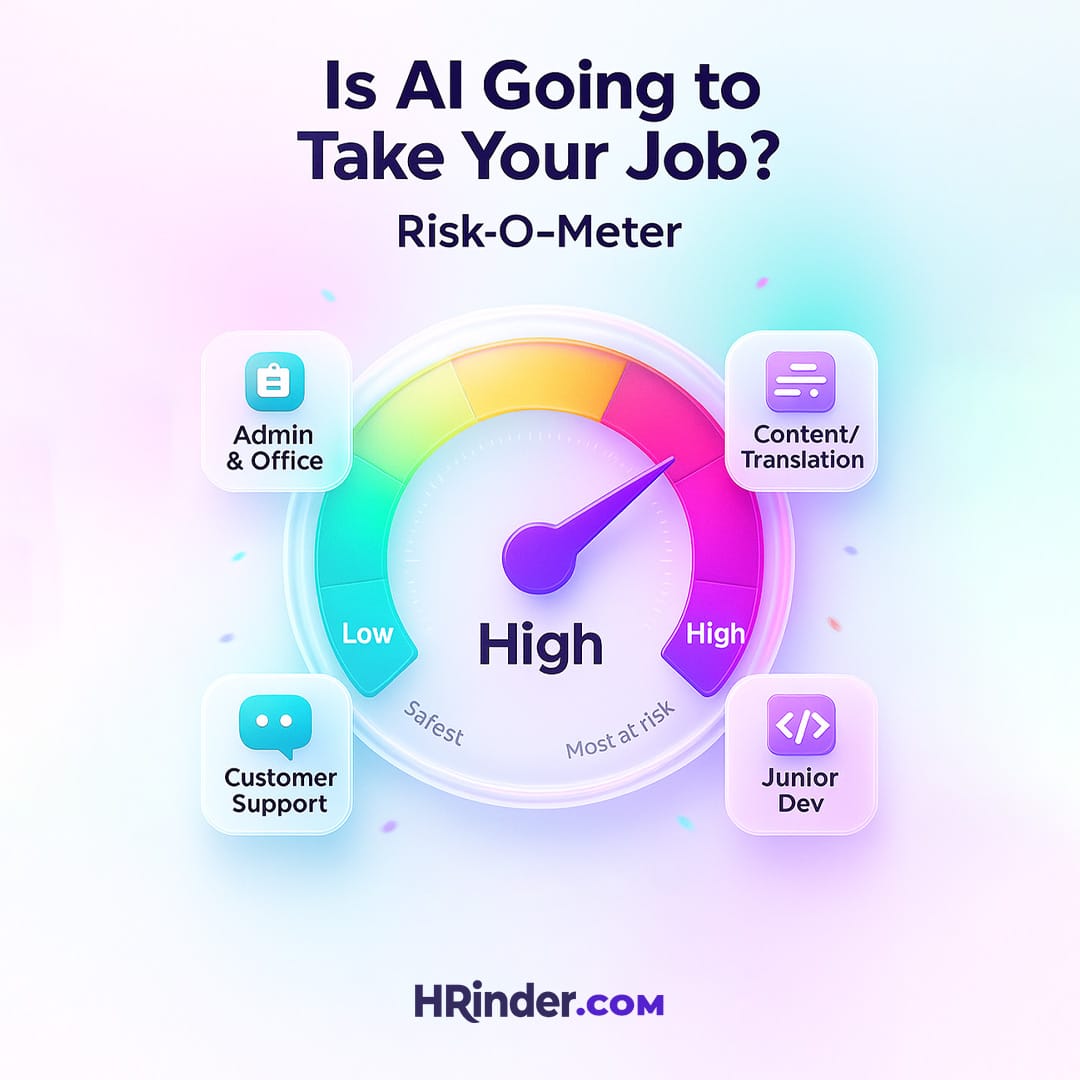
The conversation about Artificial Intelligence (AI) replacing jobs is nowhere more intense than in the IT sector. The very tools we create - Generative AI, advanced automation, and sophisticated machine learning - are now turning their transformative power on the roles we hold.
💥 The Shift: From Execution to Oversight
In the world of IT, the line of work most at risk is the repetitive, rules-based execution. The roles that are safest are those focused on strategy, systems-level architecture, complex problem-solving, and human-machine interaction.
🚩 IT Roles Most at Risk (High Automation Potential)
These roles involve a high volume of tasks that can be broken down into repeatable, predictable steps, making them prime targets for AI and automation tools.
- Junior Software Developers & Entry-Level Coders: AI tools can now generate, debug, and refactor significant portions of standard code. The role shifts from writing boilerplate code to reviewing, integrating, and optimizing AI-generated code.
- Data Entry and Processing Specialists: Tasks like transforming and migrating large, structured datasets are now highly automated by AI and ETL tools, significantly reducing the need for human input in these routine areas.
- Basic Technical Support: AI-powered chatbots and sophisticated knowledge base systems can handle a majority of frequently asked questions and initial troubleshooting steps. Human agents will focus on complex, non-standard customer issues.
- Quality Assurance Testers: Automated testing frameworks, increasingly enhanced by AI to generate test cases and identify edge-case bugs, are diminishing the need for human testers in repetitive execution roles. The focus shifts to strategic test planning and exploratory testing.
🛡️ IT Roles Least at Risk (High Augmentation & Strategic Skill)
The future-proof IT professional is the one who focuses on the "why" and "how" of technology - not just the "what." These roles leverage uniquely human skills to manage and direct the AI ecosystem.
- Cloud & Enterprise Architects: These roles require the ability to design complex and resilient IT infrastructure. AI can provide data, but the architect's judgment on cost and long-term vision is irreplaceable.
- Cybersecurity Specialists: While AI is crucial for real-time threat detection, human expertise is essential for understanding sophisticated attack narratives, defining new security policies, and performing proactive "purple team" exercises. The threat landscape is too dynamic for full automation.
- AI/ML Engineers & Data Scientists: The people who build, train, fine-tune, and ethically govern the AI models themselves are critical. This requires deep mathematical knowledge and ethical judgment that AI cannot perform on its own.
- DevOps & Platform Engineers: These roles focus on the strategic integration of tools and organizational process improvement. The ability to manage complex Continuous Integration/Continuous Delivery systems and drive cultural change is fundamentally human.
🌱 The IT Professional's Blueprint: Skills for the AI Era
The AI revolution is not about job displacement; it’s about a skills pivot. Your job security lies in your ability to partner with AI, making you a force multiplier.
Future-Proof Your IT Career:
- Become an AI Partner (Prompt Engineering): Don't just use AI tools; become proficient in directing them. Learning how to write effective prompts to generate code, scripts is now a core technical skill.
- Focus on Human-Centric Skills: Emphasize critical thinking and complex problem-solving. Your value is in interpreting AI output and applying its findings to a messy, real-world business context.
- Prioritize "The Glue" Roles: Skills in system integration and business analysis will skyrocket in value. The more tools AI automates, the greater the need for a human to manage the complexity and ensure everything works together correctly.
- Embrace Continuous Learning: Developing a growth mindset and dedicating time to mastering new AI frameworks and platforms is non-negotiable for long-term relevance.
The future of IT is not about working against AI; it's about harnessing it to elevate the human role to one of innovation and strategy.
🤔 What new AI tool are you currently mastering to future-proof your tech skills? Share your thoughts below!