
💡 The IT Talent Dilemma: Are Your Hard Skills Enough Anymore?

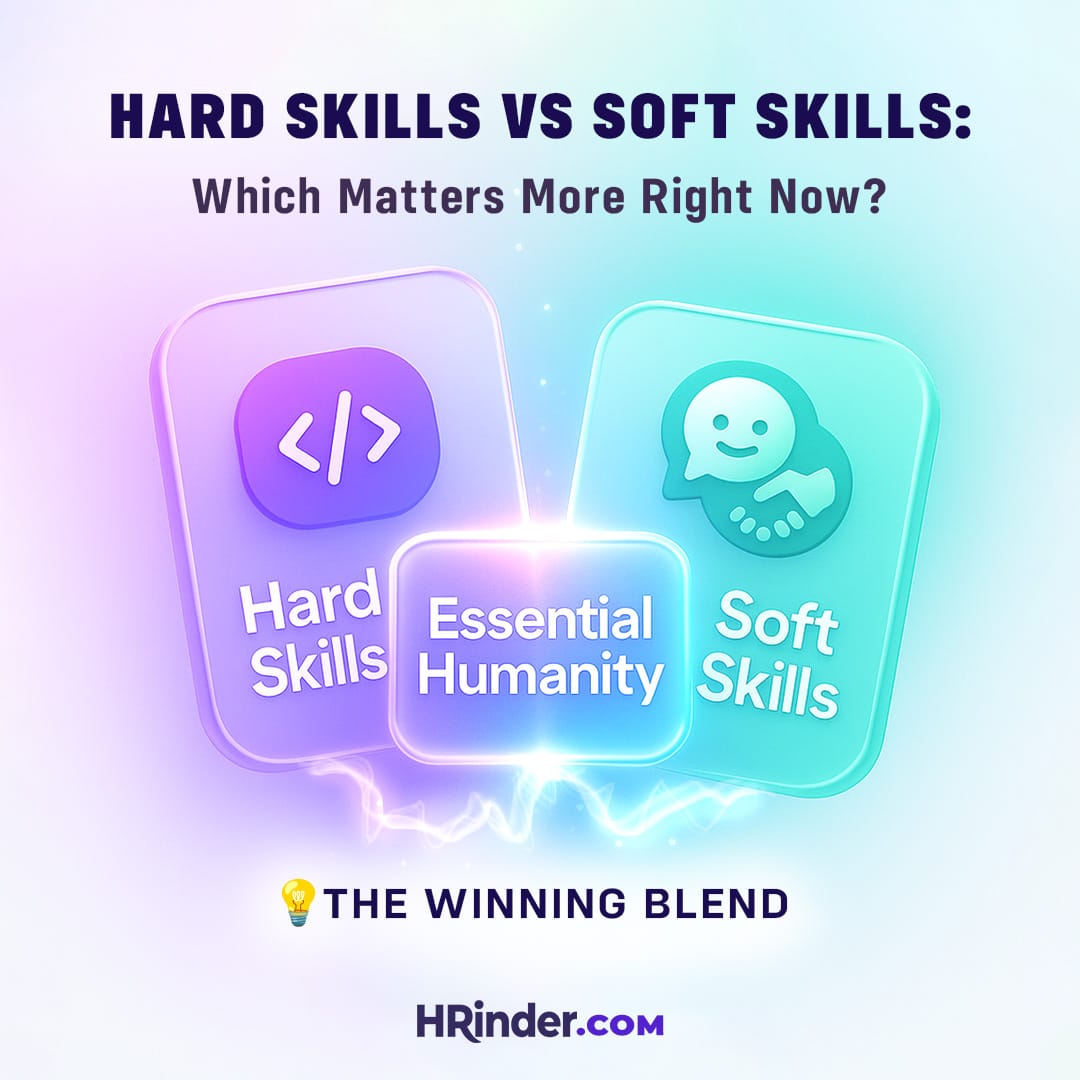
In the ever-accelerating world of Information Technology, we often prioritize the tangible: the latest programming language, the deepest understanding of cloud architecture, or a specific cybersecurity certification. These are your Hard Skills, and they are, without question, the foundation of every successful IT career.
But as Artificial Intelligence and sophisticated automation platforms become standard tools and even colleagues - in the tech landscape, a new truth is emerging: Your Soft Skills are now the most critical differentiator, serving as the bridge between technical expertise and real-world impact.
The question is no longer "Which one matters more?" but "How do I blend them to become an indispensable IT professional?"
The Automation Equation: Why Hard Skills Need a Human Partner 🤝
The core value proposition of Hard Skills is that they are measurable and repeatable. However, this is precisely why they are the first to be augmented or automated by AI.
Consider these scenarios:
- Code Generation: AI tools can now write boilerplate code and automate deployment pipelines.
- Data Analysis: Algorithms handle complex regressions and predictive modeling faster than any human.
- Network Monitoring: Automated systems detect anomalies and initiate fixes without human intervention.
This means that for the modern IT professional, the focus must shift from executing the repetitive task to defining and collaborating on the solution.
The IT Job of the Future: It's not the person who writes the cleanest code; it's the person who can understand the business problem and lead a diverse team through implementation.
The New High-Value Skills: IT's "Durable" Soft Skills
In the AI era, Soft Skills function as durable skills - they are resistant to automation because they rely on empathy and complex human interaction.
Here are the Soft Skills that are commanding the highest premium in today's IT job market:
1. Critical Thinking and Problem Definition
The AI gives you an answer; critical thinking helps you ask if it's the right question. The ability to analyze ambiguous client needs, define the technical requirements is now the most important job of a Senior Engineer or Architect. You must move beyond fixing a bug to preventing systemic failures.
2. Effective Communication
This is arguably the most vital soft skill in IT.
- The Upward Skill: translating complex technical jargon into clear business impact.
- The Downward Skill: clearly documenting and setting expectations for junior staff or end-users.
3. Adaptability and Continuous Learning
The IT landscape changes monthly. Mastery of a language like Python or Kubernetes is a Hard Skill; the inherent drive and ability to Adapt and quickly master the next ten emerging technologies is a Soft Skill. The ability to adapt to rapid technological change is a defining characteristic of a long-lasting career.
4. Collaboration and Empathy
Modern development (DevOps, Agile, SRE) requires intense, often cross-functional collaboration. Understanding the pressure on the operations team, the constraints of the budget team, or the frustration of the end-user is what turns a technical deployment into a successful business outcome.
🚀 The IT Career Accelerator: Synergy is Strategy
Hard skills unlock the capability; Soft skills unlock the opportunity.
As you pursue your next certification (Hard Skill), also seek out opportunities to lead a non-technical project or present a complicated architecture to an executive team (Soft Skill).
Focus on this synergy, and you won't just keep up with the changes in IT - you'll be the one leading them.
What essential soft skill do you think every IT team is currently lacking? Share your thoughts below!