
The ROI of Intelligence: How AI is Redefining the HR Bottom Line

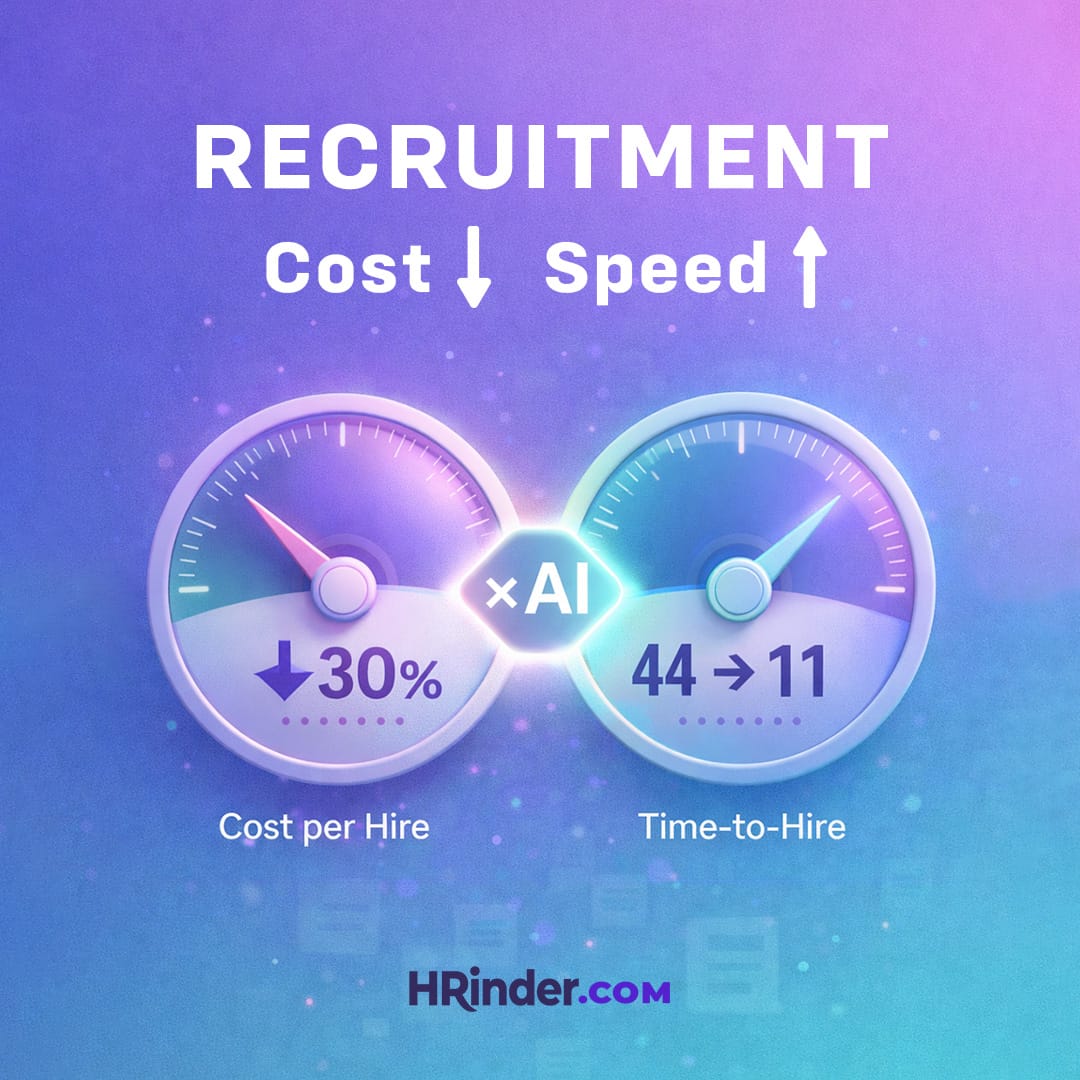
For decades, Human Resources was viewed primarily as a "cost center" - a necessary administrative function focused on compliance and manual record-keeping. However a fundamental shift is occurring.
The integration of Artificial Intelligence has transformed HR into a value-driving engine. By automating the mundane and optimizing the complex, AI is delivering measurable cost savings and efficiency gains that directly impact a company’s profitability.
🚀 Efficiency Gains: The New Standard for Speed
In a global talent market, speed is a competitive advantage. AI doesn't just do things better; it does them at a scale and velocity that was previously impossible for human teams alone.
1. Radical Recruitment Acceleration
Traditional recruitment is often bogged down by "the resume black hole." AI-powered sourcing tools now scan thousands of profiles across multiple platforms in seconds, identifying the top 5% of candidates with surgical precision.
- The Result: Companies are seeing a 60-70% reduction in time-to-fill, ensuring that critical roles don't stay vacant for months.
2. The 24/7 Employee Experience
The modern workforce expects instant answers. AI-driven "People Portals" and chatbots now handle the vast majority of internal inquiries - ranging from benefits enrollment to policy clarifications.
- The Result: HR Business Partners are reclaiming roughly 15 hours per week that were previously spent answering repetitive emails, allowing them to focus on high-level talent strategy.
3. Automated Onboarding and Compliance
AI workflows now handle the "paperwork" of new hires. From automated background checks to personalized training schedules, AI ensures that compliance is met without a single manual checklist.
💰 The Financial Impact: Where the Savings Live
Efficiency is great, but for the C-suite, the "bottom line" is the ultimate metric. AI in HR provides a clear path to reducing operational overhead.
📉 Lowering Cost-per-Hire
By utilizing AI for sourcing and initial screening, organizations are drastically reducing their reliance on expensive third-party headhunters and recruitment agencies.
- Financial Impact: Internal AI tools can reduce external recruitment spend by 30% or more, saving mid-sized firms hundreds of thousands of dollars annually.
📉 Mitigating the Cost of Turnover
Replacing an employee is expensive - often costing 1.5x to 2x their annual salary. AI predictive analytics can now identify "flight risks" by analyzing engagement patterns and performance data.
- Financial Impact: By intervening early with personalized retention strategies, companies can reduce churn by 20-30%, effectively keeping millions of dollars in institutional knowledge within the building.
📉 Precision Training ROI
"Spray and pray" training programs are a massive waste of budget. AI analyzes individual skill gaps to recommend hyper-personalized learning paths.
- Financial Impact: Organizations save on wasted training hours and see a faster "time-to-productivity" for new hires and promoted staff.
🧠 The Strategic Shift: From Admin to Architect
Perhaps the most significant gain isn't found in a spreadsheet. It’s the elevation of the HR professional. When AI handles the data entry, the screening, and the scheduling, HR leaders are free to do the work that machines cannot:
- Culture Building: Creating an environment where people actually want to work.
- Complex Problem Solving: Navigating sensitive employee relations and organizational design.
- Leadership Coaching: Developing the next generation of executives.
Summary: The Future is Automated (and Human)
AI in HR is no longer about "doing more with less." It’s about doing better with more. More data, more speed, and more focus on the human element. The cost savings and efficiency gains are simply the foundation upon which a more agile and human-centric organization is built.
Is your organization leaving money on the table by clinging to manual HR processes?