
The Talent Trifecta: Should You Build, Buy, or Borrow?

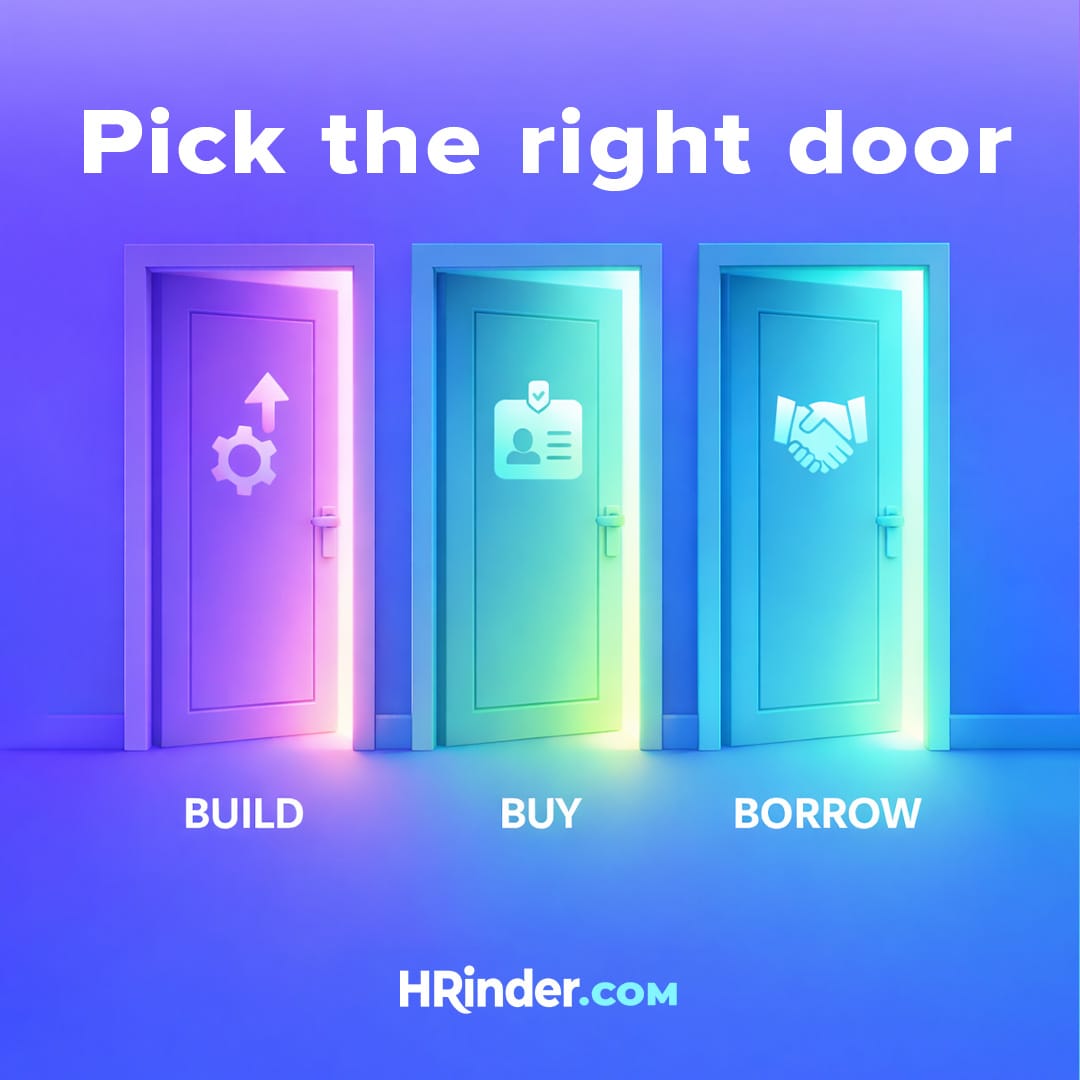
In the rapidly evolving landscape of modern business, the "talent gap" is more than just a buzzword - it’s a constant hurdle. When a new project lands on your desk or a technical shift occurs in your industry, you are faced with a critical strategic choice: Build, Buy, or Borrow.
Getting this decision wrong can lead to wasted budgets or high turnover. Getting it right, however, creates a lean and high-performing organization.
Here is a deep dive into the three pillars of talent strategy and how to choose the right path for your business.
1. The Build Strategy: Investing from Within
The Concept: Upskilling and reskilling your existing workforce to meet new demands.
Building is a long-term play. It focuses on taking the institutional knowledge your employees already possess and layering new skills on top of it through training and professional development.
- When to use it: When the skills needed are unique to your company’s "secret sauce" or when you have high-potential employees looking for growth.
- The Advantage: It significantly boosts retention and morale. Employees feel valued when you invest in their career path, and you don’t have to worry about "culture fit."
- The Challenge: It requires time. If you need a project finished by next month, you likely can’t build the skills fast enough.
2. The Buy Strategy: Acquiring Permanent Expertise
The Concept: Traditional recruitment of full-time employees (FTEs).
When you "buy," you are bringing in outside expertise to own a function permanently. This is the path of expansion - adding new seats to the table to increase your company's total capacity.
- When to use it: For core business functions that require long-term stability and deep expertise that doesn't currently exist in-house.
- The Advantage: You get an immediate injection of fresh perspectives and "proven" skills. The knowledge stays within your company walls indefinitely.
- The Challenge: Hiring is expensive. Between recruitment fees, onboarding time, the cost of a "bad hire" can be 2.5× the employee's salary.
3. The Borrow Strategy: Leveraging the Gig Economy
The Concept: Utilizing contingent labor, such as freelancers or specialist agencies.
In the age of the "fractional executive" and the "gig economy", borrowing has become a powerhouse strategy. You aren't hiring a person; you are hiring a specific outcome.
- When to use it: For short-term projects or highly specialized tasks that you don't need every day.
- The Advantage: Speed and flexibility. You can scale your team up in days and scale back down the moment the project is completed.
- The Challenge: "Borrowing" is often the most expensive option on an hourly basis. Additionally, when the contractor leaves, their specialized knowledge often walks out the door with them.
How to Make the Final Call
The most successful leaders don't just pick one; they use a mix of all three. To help you decide which tool to pull from your kit, consider this decision matrix:
- Is the skill a "Core Competency"? If this skill is what makes your company better than the competition, you should Build or Buy. Never outsource your competitive advantage.
- What is the "Time-to-Value"? If you need results in weeks, Borrow. If you have a year to develop a department, Build.
- Is the need permanent? If the task is a one-off project, Borrow. If it’s a new department, Buy.
Final Thoughts
The "Future of Work" is about agility. By mastering the balance between building your internal culture and borrowing specialized speed, you ensure your organization remains resilient no matter what the market throws your way.
Does your current workforce plan rely too heavily on one of these pillars? It might be time to diversify your talent spend.